
Every few months, national headlines report on the state of Jamaica’s economy. Statistics are cited regarding GDP growth percentages, foreign exchange reserve levels, inflation targets, and macroeconomic stability ratings from international credit agencies. On paper, the country is often described as performing admirably.
Yet, if you step into a local town square, talk to a vendor in a parish market, or tally a household budget, the lived reality tells a vastly different story. The cost of living continues to climb, basic groceries feel increasingly out of reach, and the average family works longer hours just to maintain the same baseline.
This disconnect exposes a fundamental flaw in how national prosperity is measured. Traditional metrics measure the flow of money through formal channels, but they fail to track human well-being, community resilience, or local purchasing power.
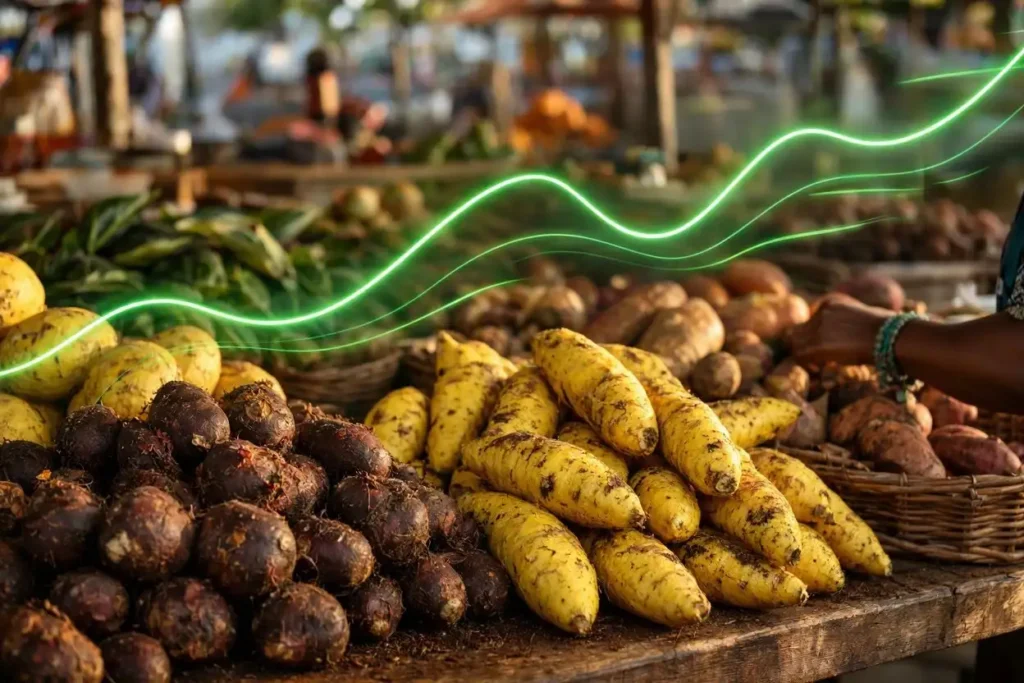
It is time to look past abstract economic reports and introduce a practical, ground-level framework: The Yam & Dasheen Index.
The Macro Disconnect: Why GDP Doesn’t Fill a Plate
Gross Domestic Product (GDP) measures the total monetary value of all finished goods and services produced within a country’s borders. While useful for high-level international trade and government borrowing, GDP has severe limitations when applied to the daily life of an average citizen:
- It Ignores Inflation’s Local Impact: If the price of essential food items doubles, spending numbers increase, which can artificially inflate economic activity on paper—even while citizens are consuming less food.
- It Favors Importers Over Local Producers: A dollar spent on imported, highly processed food contributes to commerce statistics just like a dollar spent on locally grown produce, even though the former drains foreign reserves and provides zero long-term health or agricultural benefit to the island.
- It Outsources Wealth Creation: Foreign investments in large corporate sectors may boost national output statistics, but much of that profit leaves the island rather than circulating through local communities.
+-----------------------------------------------------------+
|              THE TWO ECONOMIC REALITIES                   |
+-----------------------------------------------------------+
|  TRADITIONAL GDP METRICS:                                  |
|  • Foreign Reserve Levels                                 |
|  • Institutional Revenue & Stock Markets                  |
|  • High Macroeconomic Trade Volumes                       |
|  --> Tells us how the system is performing.               |
|                                                           |
|  THE YAM & DASHEEN INDEX (REAL WEALTH):                   |
|  • Local Food Self-Sufficiency & Yields                   |
|  • Household Purchasing Power & Savings                   |
|  • Community Interdependence & Infrastructure             |
|  --> Tells us how the PEOPLE are living.                  |
+-----------------------------------------------------------+
Defining the Yam & Dasheen Index
The Yam & Dasheen Index is a ground-level measure of true community wealth. Named after two staple crops that have historically sustained Jamaican families through economic storms, this index evaluates three core pillars of real prosperity:
1. Local Food Sovereignty
Real wealth is the ability to feed a household without total dependence on international supply chains or imported goods. The Yam & Dasheen Index tracks the abundance, accessibility, and affordability of locally grown staples relative to average daily wages. When a nation can nourish its population using its own soil, its baseline security rises regardless of global market volatility.
2. The Internal Circulation Velocity
Wealth is not just how much money enters a community; it is how many times a single dollar changes hands within that community before exiting.
- In a fragile economy, money spent at large multinational chains leaves the local ecosystem immediately.
- In a resilient economy, money spent with a local farmer goes to a local carpenter, who then buys from a neighborhood cookshop. The Yam & Dasheen Index prioritizes high-velocity, hyper-local trade networks.
3. Baseline Household Security
Instead of tracking corporate profits, this pillar measures how many days or months an average family can sustain itself during a crisis—whether caused by a natural disaster, sudden job loss, or global price spikes—without falling into immediate debt.
Rebalancing the Equation: Practical Steps for Community Growth
Transitioning to a model that values real wealth requires intentional action from both individual citizens and community leaders.
+---------------------------------------------------------------+
|               BUILDING HYPER-LOCAL WEALTH                     |
+---------------------------------------------------------------+
|  1. Practice "Local First" Purchasing                         |
|     Redirect 20% to 30% of weekly grocery spending from       |
|     imported supermarket goods to local parish markets.       |
|                                                               |
|  2. Strengthen Community Barter & Trade Networks              |
|     Trade surplus backyard produce or technical skills        |
|     directly with neighbors to reduce cash dependencies.      |
|                                                               |
|  3. Invest in Tangible, Productive Assets                     |
|     Shift savings into soil improvement, rainwater harvesting,|
|     and skill building that directly lowers living costs.     |
+---------------------------------------------------------------+
Measuring Progress by Human Flourishing
Economic reports will continue to focus on macro numbers, but true progress must be measured by the security, resilience, and independence of our people.
When a community can grow its own food, keep its dollars circulating internally, and shield its families from external shocks, it achieves a level of stability no financial report can fake. By shifting our focus to the Yam & Dasheen Index, we reclaim control over our economic future and build lasting, tangible wealth from the ground up.
Join the Conversation
The ROI Challenge: Think about your weekly household budget. What percentage of your food spending goes directly to local farmers and vendors versus imported supermarket brands? What is one change you can make this week to keep more of your dollars circulating within your local community? Let us know in the comments below.