
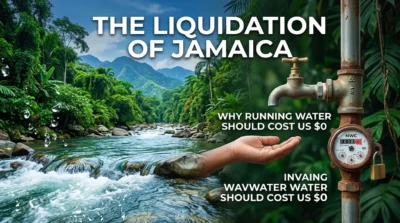
It is one of the most bitter ironies of modern Jamaican life. We proudly sing of a land blessed with “beauty all around,” and our very name, Xaymaca, honors the island as the land of wood and water. Geographically, this is an undeniable fact. Jamaica is home to over a hundred rivers, vast underground aquifers, and blue mountain watersheds that catch billions of gallons of rainfall every single year.
Yet, if you step into a Jamaican household, the reality feels entirely disconnected from nature’s abundance. Instead, we are met with dry pipes, unannounced lock-offs, trucked water expenses, and a monthly National Water Commission (NWC) bill that feels less like a utility and more like a luxury subscription.
The question we need to stop asking is, “When is the water coming back on?”
The question we need to start asking is: Why are we paying for it at all?
The Abundance Paradox: Factoring the Data
To understand why the current system is broken, we have to look at the sheer volume of resources we possess. Jamaica does not have a water scarcity problem; it has a management and distribution crisis.
According to national hydrological data, Jamaica receives billions of cubic meters of rainwater annually. A massive portion of this fresh water sits in our limestone aquifers or runs directly into the sea via our river networks. We are quite literally surrounded by and sitting on top of a goldmine of hydration.
When the NWC charges a household, they are not charging you for the water itself—nature gave us that for free. They are charging you for the cost of treating it and the energy required to pump it to your community. But because our national infrastructure relies heavily on an aging, inefficient grid powered by expensive imported fossil fuels, the financial burden of moving that water is passed directly to the consumer.
We are paying premium prices to subsidize a leaky, energy-dependent system that fails to deliver a consistent product.
Moving Beyond Commodity: Water as an Infrastructure Right
In a progressive society, certain services are understood to be foundational infrastructure. We do not receive a monthly bill from the government for walking on the sidewalk, nor do we pay a direct subscription fee for the fire department to exist. These are covered by our tax dollars because they are fundamental to public safety, commerce, and human dignity.
Clean, running water is no different. In fact, it is the absolute baseline for public health and economic productivity.
When a mother has to budget thousands of dollars every month just to ensure her children can bathe, or when a small local bakery has to shut down for two days because of an unannounced lock-off, the entire nation’s Return on Investment (ROI) takes a hit. Treating water as a market commodity rather than a public right stifles grassroots growth and keeps hard-working Jamaicans locked in a cycle of survival math.
The ROI Blueprint: How Tax Dollars Can Fund Free Water
Eliminating the water bill isn’t a utopian pipe dream; it is an engineering and fiscal calculation. If we eliminate the fluctuating cost of fossil fuels and optimize how our tax assets are allocated, a $0 water bill is entirely achievable.
1. Solarization of the Pumping Network
The biggest operational expense in moving water across Jamaica’s mountainous terrain is electricity. By aggressively transitioning every major treatment plant and pumping station to dedicated, state-owned solar farms, the recurring cost of power drops drastically toward zero after the initial capital investment.
2. The Infrastructure Tax Re-allocation
Instead of forcing citizens to pay a separate utility bill, the maintenance and upgrading of the water network should be absorbed entirely by existing tax revenues.
- By re-allocating a specific, audited percentage of national infrastructure and environmental taxes directly to a ring-fenced National Water Infrastructure Fund, we can eliminate consumer-end billing entirely.
- This shifts the focus from “profiting off scarcity” to maintaining a depreciating public asset—just like our primary roads and bridges.
3. Plugging the Leaks
Currently, a massive percentage of processed water is lost to leaks in old pipelines before it ever reaches a home. By utilizing a tax-funded model, capital can be directly deployed to replace antiquated mains with modern, high-density piping, drastically reducing waste and ensuring that the water treated actually makes it to your tap.
The Path Forward: A True Return on Life
A $0 water bill would immediately inject disposable income right back into the pockets of the working class. It would lower the overhead costs for local farmers, street side vendors, and small business owners overnight, driving an unprecedented surge in community-level economic growth.
We must shift our mindset away from accepting bare-minimum governance. If our island is blessed with natural abundance, that abundance belongs to the people who cultivate its soil and build its communities. It is time to stop liquidating Jamaica’s most precious resource for profit and start using it to revive our people.
Join the Conversation
The ROI Challenge: Take a look at your last water bill. How much did you pay for actual usage versus “service charges” and administrative fees? If that bill was permanently $0, what asset or improvement would you invest that money into for your family this month? Let us know in the comments below.