
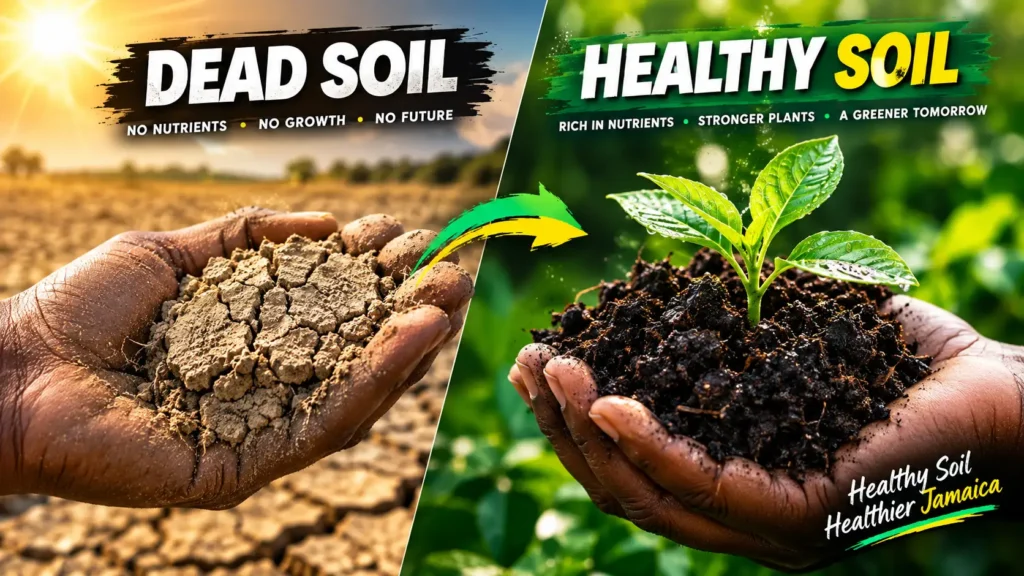
There is a quiet crisis unfolding in backyards and farm plots across Jamaica. For decades, we have been told that to grow lush scallion, thick sweet peppers, or sweet yellow yams, we must buy our way to a harvest. We have been trained to walk into farm supply stores, hand over hard-earned cash, and walk out with heavy plastic bags of synthetic NPK fertilizers and chemical sprays.
But as global supply chain disruptions and surging commodity prices push input costs higher, Jamaican backyard growers are left staring at an uncomfortable reality: our soil is becoming addicted, and our pockets are being drained.
Synthetic fertilizers do not feed the soil; they give plants a artificial, temporary high while slowly destroying the natural living ecosystem beneath our feet. The result? A hard, pale, lifeless dirt that locks up under the boiling sun and washes away at the first sign of rain.
True food freedom doesn’t come from a chemical bag. It starts by unlocking the biological wealth already sitting in your backyard—for free.
The Chemical Trap: Why Synthetic Inputs Are Breaking the Soil
To understand how to heal your dirt, you must first understand what conventional fertilizers actually do.
Synthetic fertilizers are essentially concentrated mineral salts. When applied to the ground, they dissolve rapidly in water, delivering a sudden surge of nitrogen, phosphorus, and potassium straight to the roots. To the untrained eye, the quick burst of leafy green growth looks like a success.
+-----------------------------------------------------------+
|              THE SYNTHETIC FERTILIZER CYCLE               |
+-----------------------------------------------------------+
|  1. Apply Chemical Salts -> Sudden Plant Growth           |
|  2. Salts Kill Beneficial Soil Microbes & Worms           |
|  3. Soil Compacts, Dries Out, and Loses Organic Matter    |
|  4. Plant Can No Longer Draw Nutrients Naturally          |
|  5. Result: You Are Forced to Buy More Fertilizer         |
+-----------------------------------------------------------+
Beneath the surface, those chemical salts act like sterilizing agents. They burn the delicate fungi networks, destroy beneficial soil bacteria, and drive away earthworms. Over time, the organic matter—the sponge-like material that holds water and nutrients—disappears.
Once your soil loses its living biology, it becomes compact “dirt.” At that point, the plant can no longer feed itself naturally, forcing you into a continuous cycle of buying expensive store-bought inputs.
The Rehabilitation Blueprint: Building Black Gold for $0
Living soil is self-sustaining. The natural tropical landscape of Jamaica—from our deep rainforest floors to uncultivated hillside bush—grows massive trees and vegetation without a single bag of shop fertilizer. It does this through a continuous cycle of organic decay and regeneration.
Here is how you can replicate that exact process in your backyard using 100% free local materials.
1. The Backyard Layered Compost System
Instead of burning yard waste or throwing kitchen scraps in the garbage, combine them to create rich, dark humus.
- “Greens” (Nitrogen): Fruit scraps, green leaves, coffee grounds, fresh grass clippings, and vegetable trimmings.
- “Browns” (Carbon): Dry leaves, coconut husks, shredded cardboard, dry sugarcane bagasse, and sawdust.
- The Ratio: Layer two parts “Browns” to one part “Greens” in a shaded corner of your yard. Keep it damp like a wrung-out sponge. Within 6 to 8 weeks, microbial activity will break this down into rich, earth-scented compost loaded with bio-available nutrients.
2. Native Leaf-Mold Extract (“Forest Tea”)
Walk under any dense clump of trees or fruit trees in your community and scrape back the top dry leaves. Beneath them, you will find a layer of dark, crumbly earth woven with thin white threads (beneficial mycorrhizal fungi).
- Take a few handfuls of this microbially rich forest floor earth and place it in a porous cloth bag.
- Submerge the bag in a bucket of unchlorinated water (rainwater or river water) for 24 to 48 hours.
- Pour this dark, living liquid around the root zone of your backyard crops. You are directly inoculating your depleted soil with millions of local micro-organisms designed by nature to thrive in the Jamaican climate.
3. Bio-Char & Wood Ash (The Potassium Booster)
If you burn untreated firewood, coal, or coconut shells, do not throw away the ash and charcoal bits.
- Crushed Charcoal (Bio-Char): Acts like a microscopic sponge inside the soil, housing beneficial bacteria and holding onto water during dry spells.
- Wood Ash: Highly rich in potassium and calcium. Sprinkle light dusting around fruit-bearing plants (like tomatoes, peppers, and sweet potato) to encourage strong flowering and firm fruit production.
The Personal ROI: Calculating the Value of Soil Independence
Restoring your soil isn’t just an environmental statement; it is a direct financial investment in your household’s bottom line.
+-------------------------------------------------------------+
|                 THE BACKYARD ECONOMIC RETURN                |
+-------------------------------------------------------------+
|  CONVENTIONAL METHOD:                                       |
|  • 50kg Bag of Synthetic Fertilizer: ~$7,000 - $9,000 JMD   |
|  • Chemical Pesticides/Fungicides:   ~$3,000 - $5,000 JMD   |
|  • High Water Bill (Dead soil doesn't hold water)          |
|                                                             |
|  THE ROI REVOLUTION:                                        |
|  • Homemade Organic Humus:            $0 JMD                |
|  • Inoculated Native Soil Teas:       $0 JMD                |
|  • Moisture Retention (High organic matter reduces watering)|
+-------------------------------------------------------------+
When you rebuild your soil’s organic matter, it retains up to 20 times its weight in water. That means less watering, lower water bills, and crops that survive hot dry spells without scorching.
More importantly, crops grown in living, microbe-dense soil develop stronger immune systems natively, dramatically reducing the need for chemical pesticides.
Reclaiming Food Sovereignty from the Ground Up
A nation that cannot feed itself from its own earth is always at the mercy of global price shocks and corporate importers. By shifting our mindset from “buying plant food” to “building soil life,” we take the first step toward true self-reliance.
Your backyard isn’t just a patch of dirt—it is a production asset waiting to be activated. Stop throwing away your organic waste, stop buying chemical salt bags, and start building the black gold that will feed your family for generations.
Join the Conversation
The ROI Challenge: Go into your backyard today and dig up a handful of dirt. Is it dark, moist, and full of earthworms—or is it hard, dry, and pale? Take a photo and share your soil story in the comments below. What free materials in your community can you start composting this weekend?